Let me start with a confession. I say it too. Somebody tells me something hard, out comes “oh my god, me too”, or “I’ve gone through that”, and for a second it feels great to share a kindred moment. But more often than not it stops the conversation getting any deeper, and in a professional setting that gets expensive quickly.
The obvious move would be to stop saying it, but that isn’t quite right either. Frankly, you can say it as often as you like and truthfully share a moment. Reaching for your own version doesn’t stop you caring about the person, which is exactly why it feels fine from the inside. However, if you were hoping to deepen your understanding and really help that other person unpack, then you have just interrupted that connection with a speed bump.
So why doesn’t it work? It swaps the attention over to you, and the connection and the flow of the conversation come with it.
So I ran the first Sensing Skill Drill to find out whether any of this is trainable, rather than just true. Six people, ninety minutes, three countries, and a set of scores at both ends.
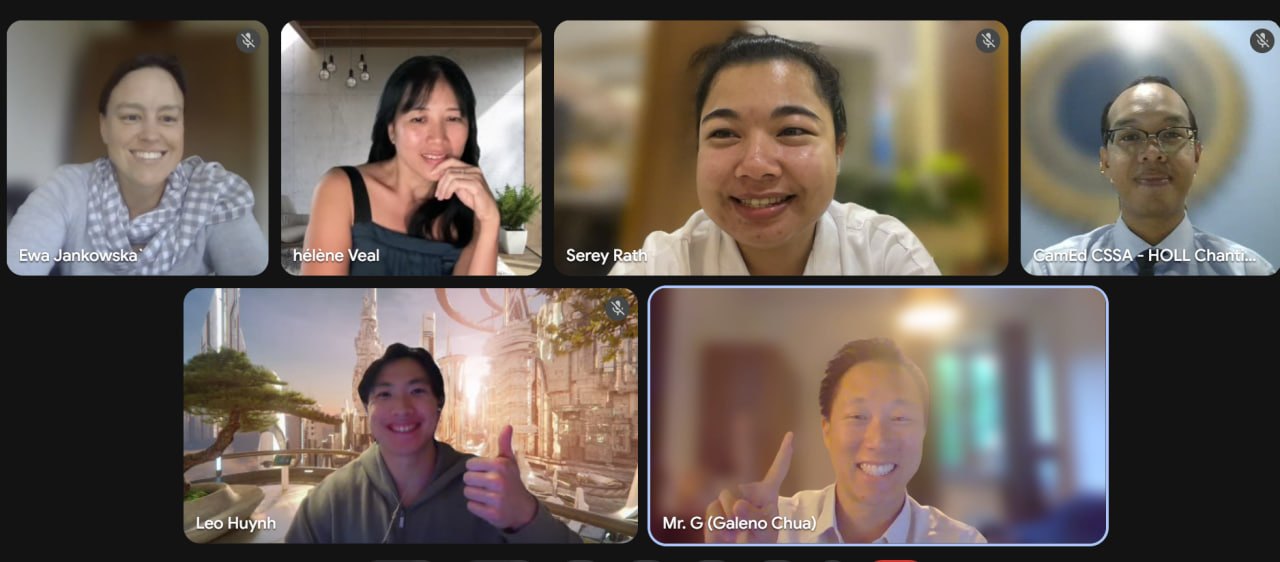
The six of us on a Thursday morning, spread across Cambodia, Poland and New Zealand.
The rule
The drill is built on the contemplative dyad, which is a studied format rather than something we invented. One person speaks and the other only senses, meaning no advice, no fixing, no reassurance and no responding at all. Then you swap. Not being allowed to reply is how you find out what you do instead.
The research is Tania Singer’s ReSource Project at the Max Planck Institute, 362 adults, randomised, ten-minute dyads five times a week for nine months against solitary meditation. Closeness rose in every session and kept rising across the whole nine months. People also rated the dyads less motivating than meditating on their own, 9.3 against 11.2, and turned up anyway. So if this sounds less appealing to you than sitting quietly by yourself, that is the normal finding rather than a reason to skip it.
We ran four minutes, then six. Try it for four with somebody you have never met and see how long it takes to want to speak.
Everybody finds it uncomfortable, and the discomfort is exactly what makes it work. When you can’t respond, the person talking knows nothing is going to be done with what they say, no advice, no fixing, no well-meant solution they didn’t ask for. And that, it turns out, is what lets them say it at all. Everyone in the room got there, each in their own words.
Someone else is sort of forced, in a way forced by the means of the exercise, to listen to you, and it is a really safe space. You sort of know that you can just pour your thoughts… It is your time to be.
And Serey Rath of The Idea Consultants:
It is like writing a postcard, back before we had telephones. Every word is limited, so every word is valuable. You do not expect a reply, and you might even lose the letter. These days we text, hi, how are you, and it is fast. This was the other thing. Short, meaningful, unforgettable.
One argued it from safety and the other from scarcity, and neither was told to. The restriction is the mechanism, which is why both of them reached for it unprompted.
Sensing yourself gets sharper when you stay with them
Almost everybody thinks that connecting with someone else means listening really, really well to the other person, and to what they are saying. It’s mostly right! However, it assumes there is nothing left over to notice what is going on with you.
One of the participants worked it out mid-session. It is not a trade-off at all. Sensing yourself gets sharper the more completely you are attuned to somebody else, not blunter.
That’s why some of the world’s best interviewers, coaches and leaders seem to ask such fantastic questions, or share an insight so quickly. The listening is only the part you can see. They are acutely in flow with their own intuition, and they trust it.
Past a certain point you stop trying to connect, because you already are, and whatever turns up then turns up in your own body. Your intuition. Your own discomfort, or your own lift. It stops being something you're doing to them and becomes something the two of you are in together, which is a very different thing to be in a room with.
The moment you drop out to check your own story, you lose both at once. You lose them, and you lose the read on yourself that was telling you what was happening.
So the skill here isn’t learning how to connect, because most of us can already do that when we want to. The skill is staying once you are there, and “I’ve gone through that” is how most of us leave.
Two opposite listeners, one missing half
Another pair got to the same place from the outside. One of them came in wanting to solve the problem, which I suspect is most of us, and his partner's instinct was to step into the other person's position first. Comparing notes afterwards, the first one said:
A really good insight that came out of that was that you actually need his side first, to actually give advice.
His partner had come at it from the other end, that sometimes people don't want advice at all and just want to be understood. Neither of them had been taught the order. They ran into each other and worked it out between them, which is the whole reason we do this in pairs rather than as a lecture.
What the scores say
Everyone scored themselves on four dimensions of sensing, practised, then scored themselves again on the same four. Both readings came after the teaching, so at least they sit on the same ruler, which was the entire point of scoring twice.
I say at least, because the second reading was supposed to be taken straight after the teaching and before the second round, and I skipped it at the moment it was meant to run. So we can’t say how much the teaching shifted anybody’s standard, only how the two rounds compared. The number I was most curious about is the one I lost, and there is no honest way to reconstruct it.
| Sensing dimension | Before | After | Change |
|---|---|---|---|
| How well did I sense others? | 3.8 | 4.2 | +0.4 |
| How present was I? | 4.2 | 4.2 | 0 |
| How well did I sense myself? | 3.0 | 3.4 | +0.4 |
| How well did others sense me? | 4.0 | 4.0 | 0 |
Sensing yourself came out lowest at 3.0, and three of the five took it as their ninety-day focus. That's the pattern the drill is built to produce, where you leave with your weakest dimension and one practice attached to it. It’s also, you’ll notice, the exact dimension people arrive convinced they have to trade away in order to pay proper attention to somebody else.
The two scores that did not move
Presence didn’t shift at all as a group average, and it was the one dimension where somebody scored themselves down. That’s awkward for me, because presence is the thing a sensing drill ought to be best at.
I think the tally is why. We asked observers to mark the page each time their mind drifted and each time they bit back a response, so that scoring their own presence would rest on evidence rather than a feeling. One participant abandoned it inside the first minute and told me plainly: you can attend to your partner or you can attend to yourself, not both at once.
She’s right, and I’d put it this way. A tally is a tactical tool and it earns its place when somebody has been told they are a poor listener, or too wrapped up in themselves, and needs to measure that one thing in order to manage it. Nobody in this room needed that. So for them it wasn’t measuring presence, it was costing them presence, and it becomes optional from here.
And how well did others sense me didn't move for a single person, in either direction. Five out of five unchanged is not a result you get to shrug at. My read is that people carry a fixed story about how legible they are to everybody else, and ninety minutes doesn't go anywhere near it. That one probably needs a different exercise altogether.
What held up
The three-layer check, physical then mental then emotional, was taken at the start of the session and again at the end.
| How the room felt | Start | End | Change |
|---|---|---|---|
| Physically settled | 3.4 | 4.4 | +1.0 |
| Mentally clear | 3.0 | 4.2 | +1.2 |
| Emotionally steady | 3.4 | 4.0 | +0.6 |
I wrote down at the time that nothing had actually been resolved for anybody, and that turned out to be wrong. Two of them had something shift, and we only found out because they told us afterwards. Rath got through something she had not managed to say out loud before, and her reason was the format itself: she had been given enough room to simply talk, with nobody waiting to jump in.
The instrument missed the best thing that happened in the room, which is worth sitting with given how much of this piece is about measurement. One participant did describe the effect before she’d seen a single number, saying she left energised even though the topic hadn’t been easy and nothing had been fixed.
Ninety minutes of being properly listened to leaves people clearer, without anything being solved. That's a small claim from a small room, and I'll say the limits out loud because you'd be right to ask, five sets of scores, one session, no control group. But the numbers and the room arrived at it separately, and that's worth more than either of them on its own.
What I do differently now
I still say it. Somebody tells me something hard, I can feel it coming, and most of the time now I can let it go and stay with them. They never know I nearly left.
If you want one thing from all of this, it is that moment before you say it. Notice it in your next hard conversation, once, and say nothing. What the other person does with that room is the experiment, and you will not need a score to see it.
Take the sheet
Everyone asked for the same thing afterwards, which was something to keep beside them. So the Sensing Cheat Sheet is one page, it prints, and it keeps the tactics for sensing during a conversation well away from the tactics for analysing one, because in the room those two turned out to pull against each other.
The next Skill Drill is Public Speaking, 22 October. Details are on the Skill Drills page.
With thanks to everyone who sat in that room and said true things to strangers. Quotations are used with permission.